The Eiffel Tower, night after night, dons its distinctive golden lighting and sparkles for 5 minutes every hour, while its beacon illuminates Paris. With an initial height of 300 meters, which later changed with the arrival of a 24-meter antenna, the Eiffel Tower was the tallest structure in the world for 41 years. The Eiffel Tower is made of iron, not steel. The iron for the structure comes from the Lorraine region in France. During its first year, the Eiffel Tower was visited by more than 2 million people, but it now receives more than 6 million people every year.
• The iron of the Eiffel Tower underwent a refining treatment called puddling, which allowed for the removal of excess carbon during the smelting of the ore. • This treatment made it possible to obtain almost pure iron, which, in Gustave Eiffel's opinion at the time, was the best and most robust material. • To protect it from corrosion, the iron is coated with a thick layer of paint, which must be renewed every 7 years, as recommended by Gustave Eiffel himself.
For decades, the Eiffel Tower has also had its replicas: • The oldest is the Blackpool Tower, located in Lancashire, in Northern England. It was later dismantled and transported to the construction site of the Eiffel Tower for reassembly. It was built in 1894 and is 158 meters tall. • The most similar, at 165 meters tall and perhaps the most famous, is the Eiffel Tower in Las Vegas, USA. • Two American cities named Paris, in Texas and Tennessee, also have their replicas. • The Tokyo Tower, inaugurated in 1958, with a height of 333 meters, also resembles the Eiffel Tower. • It is also possible to find replicas in China, the Czech Republic, Romania, and Russia.
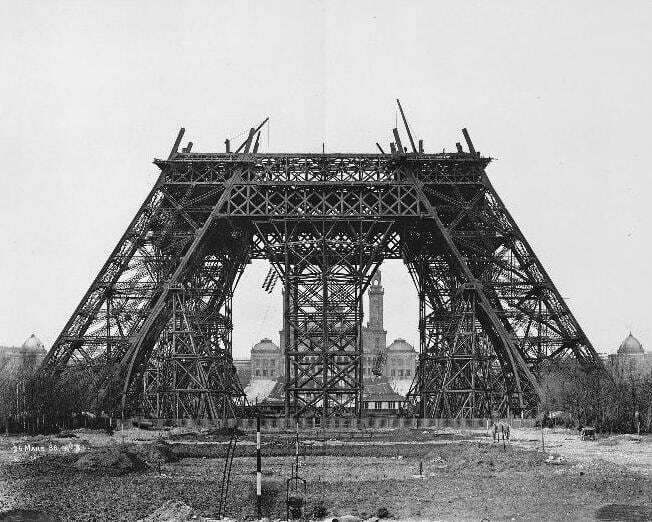
The Eiffel Tower is France's most famous architectural landmark. Designed by Gustave Eiffel, after whom it is named, it was erected for the 1889 World's Fair, the same year as the centennial of the French Revolution. It was inaugurated on March 31, 1889, and was a technical feat for its time: its construction was completed in a record time of 2 years, 2 months, and 5 days. The Eiffel Tower was originally designed to last only 20 years. Nevertheless, it was saved thanks to the scientific experiments promoted by Gustave Eiffel. Visitors can access the first two floors by elevator or stairs. In 2003, the tower's lighting was changed. Access from the second floor to the top is by elevator. The first renovation was carried out in 1900, and since then the monument has been renovated, restored, and adapted on several occasions to accommodate an increasingly large audience. The plates and beams were pre-assembled at Gustave Eiffel's factory in Levallois-Perret, with the help of rivets. For this, it was necessary for 25 climbers to manually place 20,000 bulbs (5,000 on each side) over 5 months. Since then, it has survived two World Wars, and personalities from all walks of life and from all over the world have visited it.
- It has three floors open to the public. Floors two and three are made up of two levels (a lower covered level and an upper level open to the outside).
- In particular, it was used to test the first radio transmissions and later as a test bench for television.