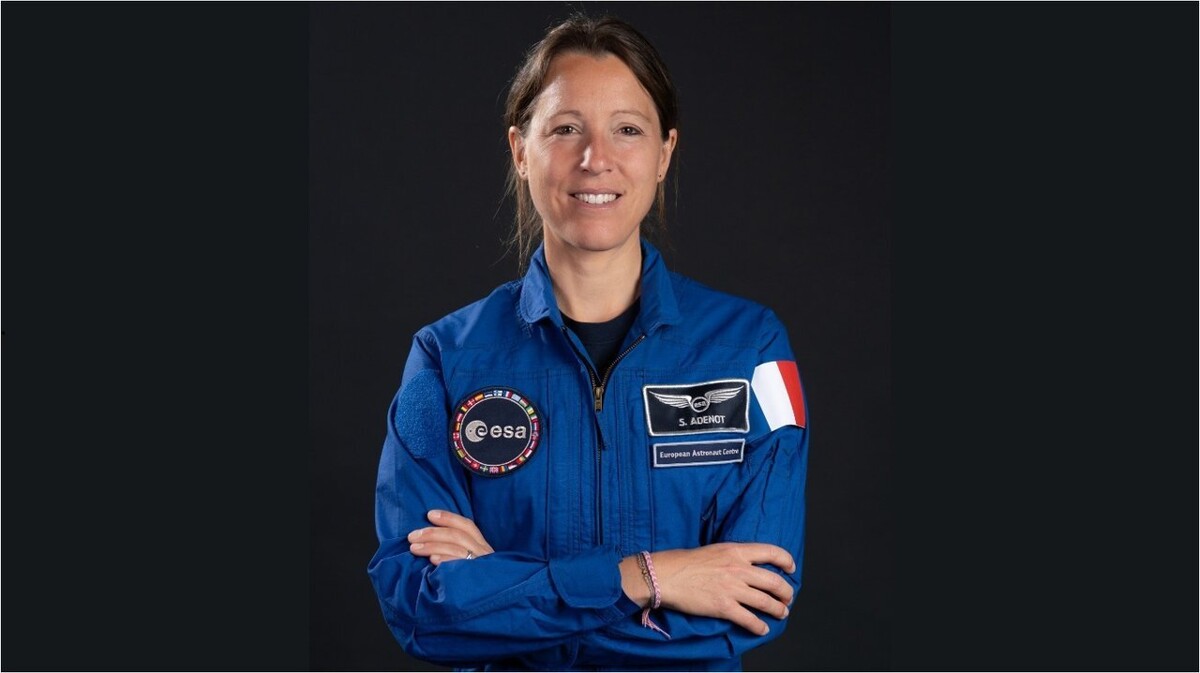
Sophie Adenot, who went from repairing cars to working on airplanes, was inspired by his stories. The woman calculates that at the age of 10, her desire to become an astronaut was born after reading biographies and stories of “aviators and explorers”. A pioneer who motivated her The trigger was Claudie Haigneré, the first French woman in history to “touch” the stars with her finger. Haigneré first took off in 1996 for the Russian Mir space station, when Adenot was 14 years old and was pasting the articles she read on her desk. Later, with a master's degree in hand, she signed in 2004 with Airbus Helicopters as an engineer in the field of cockpit design. From 2008 to 2012, she worked as a helicopter pilot in a squadron specializing in search and rescue missions, and then in the transport of government authorities. She finally became the first French female helicopter test pilot in the Air and Space Force. “I love being a helicopter pilot! I love to take off, see the Earth from above, test new hardware, test the limits of a machine in a complex environment, go as far as technology can go,” she now analyzes. When the European Space Agency opened applications for its new class of European astronauts, Sophie Adenot was quick to apply. “That's what makes me happy,” she affirms. From the helicopter to space “Taking off in a space vehicle is a bit like being in a helicopter cockpit,” she says. Daughter of a notary and a pharmacist, she now celebrates her happy childhood in which “curiosity was fostered,” according to a chronicle on the RFI site observed by the Argentine News Agency. Grandfather mechanic, an inspiration The Adenot family story says that one of Sophie's grandfathers played a decisive role when he joined the French Air Force as a mechanic. In November 2022, her resume caught the recruiters' attention and she was selected among 22,500 candidates. Her training was intensive; she learned Russian, improved her biology knowledge, practiced extravehicular activities in a huge tank in Cologne, and learned to operate the robotic arms of the International Space Station. She even contacted Claudie Haigneré and explained: “Sometimes she writes to me saying: ‘Sophie, I don't want to bother you, but if you ever need me, I'm here.’ Some conversations with her really helped me to move forward.” Her current British colleague, Rosemary Coogan, remembers a group conversation with the French woman: “We knew she had a good chance of going first, so she told us: ‘When I'm on the ISS, I will give you complete reports, I will keep you informed of my mission, I will share it with you’.” Sophie Adenot will also participate in an educational experiment developed by the National Center for Space Studies (CNES), in collaboration with 4,500 French schools. The idea: to make small plants germinate simultaneously on the ISS and on Earth to observe the effects of gravity and light on the growth of these plants.