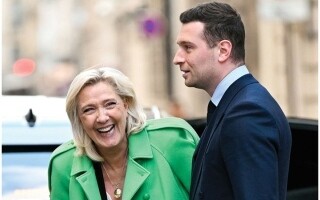
France's National Rally party is under increasing pressure to secure a major victory in the municipal elections starting tomorrow. Many observers view these elections as a crucial political test for the party, known for its strict stance on migration, especially as they precede next year's presidential elections, making them an important indicator of the party's popular support. During a campaign stop last month in the southern French city of Carcassonne, Bardella emphasized the significance of these elections, stating that major political shifts typically begin at the local level. Often, temporary alliances are formed between other political forces before a runoff election to prevent far-right candidates from winning. This was clearly evident in the early elections of 2024, when the National Rally was considered the frontrunner, but a coalition of left-wing parties ultimately managed to turn the tables and secure victory. However, supporters of the party believe that the circumstances this time may be more favorable for them compared to the past. The municipal elections will likely provide the clearest indicator to date of the National Rally's ability to translate its growing popularity into tangible influence at the local level, which will also shape the landscape of the upcoming political battle in the presidential elections. Municipal elections in France are often influenced by local figures and issues specific to each city or town, which can reduce the impact of the broader political trends that contributed to the rise of the right-wing movement nationally or in Europe. An analyst added that this significant development suggests that the so-called 'glass ceiling,' if it ever existed, has risen considerably in recent years. Nevertheless, the question of whether this ceiling has actually been shattered remains a subject of wide political debate. In other words, the general political mood does not always directly reflect the results of ballot boxes in local elections. Furthermore, France's two-round electoral system traditionally poses an obstacle for Le Pen's candidates. This political cooperation is known as the 'Republican Front,' a strategy based on coordinating efforts between centrist and left-wing parties to counter the far right by withdrawing some candidates to avoid splitting the opposition vote. In this context, a senior official in the National Rally, who preferred to remain anonymous, stated that the 'Republican Front' has become merely a legend, affirming that the party's strength has increased with every electoral cycle in recent years. Some opinion polls suggest that the National Rally and its allies could achieve strong results in Marseille and Nice, France's two largest cities, where the population of these cities far exceeds that of the largest city currently governed by the party, Perpignan. Medium-sized cities such as Nîmes and Toulon are also among the municipalities experiencing intense electoral competition. On the other hand, Clémentine Alexandre, a research analyst at the French polling firm 'Ifop' and also author of a report on the National Rally's municipal campaign, stated that the party's past experiences in power are still important for political analysts and voters with longer political memories, but she also pointed out that a new generation of the party's voters may not give the same weight to those old experiences. Alexandre believes that if the National Rally fails to achieve strong results in cities where polls show high support for it in presidential elections, it could reinforce the belief in the existence of a so-called 'glass ceiling' that limits the far right's political progress and access to power. In contrast, party spokesman Alexandre Nicolas appeared more optimistic. He pointed out that the party has seen a significant growth in its parliamentary representation in a short period, explaining that it moved from holding just eight seats in parliament in 2022 to 142 seats in 2024. Marine Le Pen, leader of France's National Rally, and Jordan Bardella, the French politician who took over the party leadership in 2022, now face a pivotal political moment that requires them to prove the party's ability to achieve a major victory in practice.