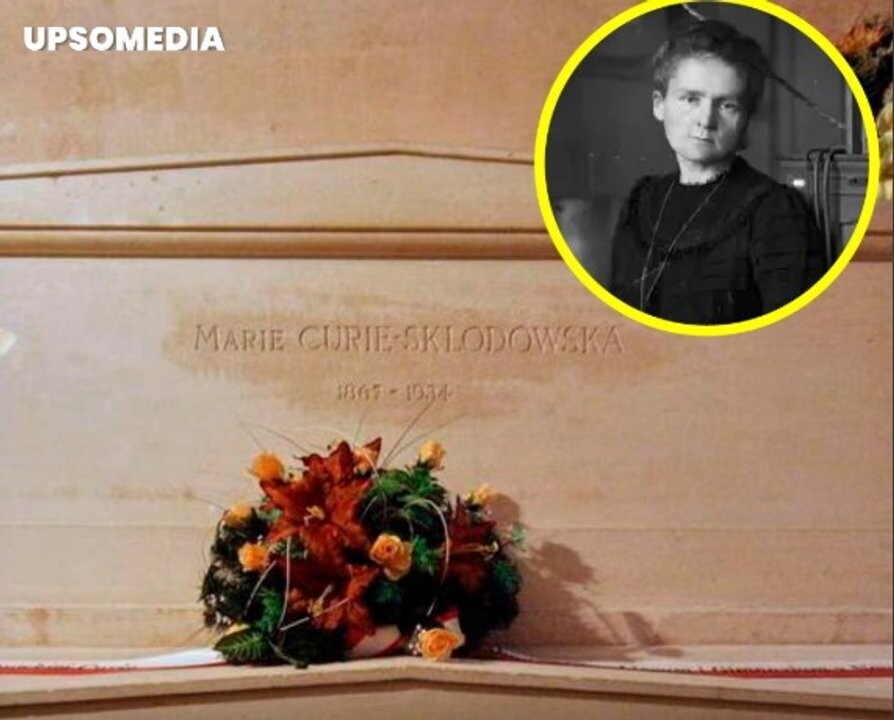
Paris, November 19 (NA) – The Polish scientist, naturalized French, Marie Curie, a pioneer of radioactivity and the only person to win two Nobel Prizes in different scientific disciplines, rests in the Panthéon in Paris alongside her husband Pierre. However, her tomb continues to emit radiation. She discovered polonium and radium without any protection, handling highly radioactive materials that eventually caused her a fatal illness in 1934, as reconstructed by the Argentine News Agency. Decades later, when her body was exhumed to be transferred to the national mausoleum, French authorities confirmed that her remains were still radioactive, so they had been sealed in a 2.5-millimeter-thick lead coffin. Today, even her personal belongings are stored under special conditions due to the level of contamination, which could last 1,500 years. This serves as a reminder that the woman who revolutionized science was also a victim of the invisible power she helped discover. She was the first woman to be buried with honors "on her own merits" - as defined by the French state - in the Panthéon in Paris, a place reserved for the true glories of French history. It was in 1995 and it was then-President François Mitterrand who headed the ceremony that day.
Understanding radioactivity Maria Salomea Skłodowska was born on November 7, 1867, in Warsaw (then part of the Russian Empire) and was the youngest of five siblings in a family of educators going through financial difficulties after her father's demotion for sympathizing with Poland. She was a French physicist and chemist of Polish origin who revolutionized our understanding of radioactivity. Inspired by Henri Becquerel's discovery of uranium rays, the Curies isolated polonium (named after her homeland) and radium, coining the term "radioactivity." The process began to be used to treat cancer patients, and what we now call "radiation therapy" as part of cancer treatment was born from those investigations.
A matter of gender Denied access to the university in Poland due to her gender, she studied on her own and worked as a governess before moving to Paris in 1891 to attend the Sorbonne (University of Paris), where she earned degrees in physics (1893) and mathematics (1894). There she met Pierre Curie, whom she married in 1895 and with whom she collaborated on revolutionary research. After Pierre's tragic death in 1906, she became the first female professor at the Sorbonne and continued her work, while also raising her daughters Irène (a future Nobel laureate) and Ève. During World War I, she developed mobile X-ray units ("Petite Curies") to support medicine on the battlefield.
She won the planet's most important scientific prize, the Nobel Prize, twice: first in Physics in 1903, and second in Chemistry in 1911. Besides Curie, only four scientists, out of a total of 954, have won two Nobel Prizes. She is the only woman.