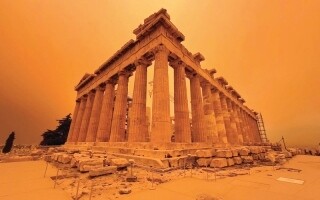
On one hand, rising temperatures lead to increased soil aridity and accelerated desertification, which facilitates the transfer of fine particles by wind. In recent years, residents of France, Spain, and the United Kingdom have witnessed an unusual phenomenon: the sun rising with an orange-tinted sky and a thick yellow haze. Often, what is known as 'blood rain' falls from the sky—rain that tends to have a rusty color, leaving a thin layer of dust on cars and windows. This phenomenon is attributed to massive clumps of Saharan dust that travel vast distances of thousands of kilometers across the Mediterranean. With the rapidly changing climate clearly affecting the world's largest desert, Europe has become more vulnerable to this escalating environmental crisis. The Sahara Desert is a major source of dust globally, contributing more than half of its total emissions. In an environment of extreme heat, drought, and frequent storms, dust particles rise to great heights in the atmosphere, allowing them to travel across continents. Although most of this dust heads towards the Americas, a portion moves north towards Europe, especially between February and June each year. Europe has experienced strong dust storms, such as 'Calima,' which sometimes hits Spain and extends to the North Sea and Scandinavian countries. A complex relationship The phenomenon of dust has a complex relationship with climate change. Predictions indicate that if severe warming continues, the amount of dust emitted from the Sahara could increase by 40-60% by the end of this century. On the other hand, the amount of dust also depends on wind patterns. Over the past two decades, a relative decrease in the frequency and intensity of some sandstorms has been observed, partly due to increased vegetation in the Sahel region, weaker surface winds, and changes in major climate patterns. The impact of this dust is not limited to the general appearance of the sky; it extends to pose a real threat to public health. It degrades air quality by raising levels of fine invisible particles known as 'PM10,' which can penetrate deep into the lungs, increasing the risk of diseases like asthma and cardiovascular illnesses. Studies in Spain and Italy have shown that Saharan dust may be responsible for up to 44% of deaths related to these particles. Furthermore, this dust has other environmental and economic consequences. When it settles on the snow in the Alps, it reduces its ability to reflect sunlight, accelerating melting. It also negatively affects the efficiency of solar panels and can disrupt air and road travel due to reduced visibility. Comprehensive efforts Addressing this growing phenomenon requires comprehensive efforts that transcend geographical borders. Limiting soil degradation in the Sahara and surrounding areas is crucial, as practices like overgrazing, dam construction, and land abandonment contribute to dust emissions. Proposed solutions include restoring vegetation, maintaining river flows, and protecting the fragile 'biological crust' composed of microorganisms that help stabilize the soil and prevent wind erosion. In turn, Europe is focusing on enhancing its preparedness to deal with the phenomenon, providing early warning systems with forecasts up to 15 days in advance, which allows authorities to issue warnings for the most at-risk populations. Simple measures can also be taken, such as improving building ventilation and increasing green spaces in cities to reduce dust exposure. An important indicator The Saharan dust belt will remain an important indicator of the planet's health in the coming years. However, relying on technology alone will not be enough, as dust does not respect borders, making it essential to strengthen international cooperation and establish binding agreements to address its causes, from water resource management to coordinating health responses. Whether the orange sky remains a rare phenomenon or becomes a regular part of life in Europe, addressing this shared challenge between Europe and Africa can no longer be delayed.